Industry knowledge
What is Web 3.0?

Everything you need to know about Web 3.0 technology, in one summary
After almost half a century of web technology, we have recently begun the transition to the third evolution, "Web 3.0." It is worth looking back at how this technology became the valuable resource it is today, and finding a good answer to the question: "What exactly is Web 3.0 technology?"
Getting to know web technology
Right now, you are using a technology we call the "web" (originally called "the Mesh") to read this blog post. Web technology, also known as the World Wide Web, is a system invented by Tim Berners-Lee in 1989. He leveraged the existing internet connection to link documents and web pages together, so that people could share information.
His inspiration came from his work as a software consultant at CERN, which brought together researchers from around the world. He noticed that it was difficult for them to share information, and realized the problem could be solved using hypertext technology.
"At the time, different information existed on different computers, but you had to log on to each of those computers separately to access it. And sometimes you had to learn a new program on each computer. Often it was just easier to ask people during the coffee break…" – Tim Berners-Lee
After Berners-Lee launched the first website for the public towards the end of 1990, he recognized its universal potential. He and his team therefore decided to make the code they had created freely available forever. With this decision, the snowball began to roll, sparking more creativity and collaboration than ever before — and it continues to this day.
It is thanks to this breakthrough that we now have access to the world via the internet, where we can communicate with each other, create content, search for and share information, or provide services without needing to ask a central authority for permission.
What is Web 3.0 technology?
The web has evolved gradually, and the third generation — Web 3.0 — will have major consequences for the world we live in. So what is Web 3.0 technology?
Web 3.0 is the third generation in the development of web technology. The newest version of web technology is highly beneficial for decentralized use and promotes broader adoption of blockchain technology. It also contributes to making machine learning and AI (artificial intelligence) systems smarter and easier to adapt.
How? The picture becomes clearer when we look back at how the technology has changed since the early days of Web 1.0.
The history of web technology
The development of the web over the past 30 years has had enormous consequences for the technology world. It has already been on a long journey in its evolution towards the Web 3.0 era.
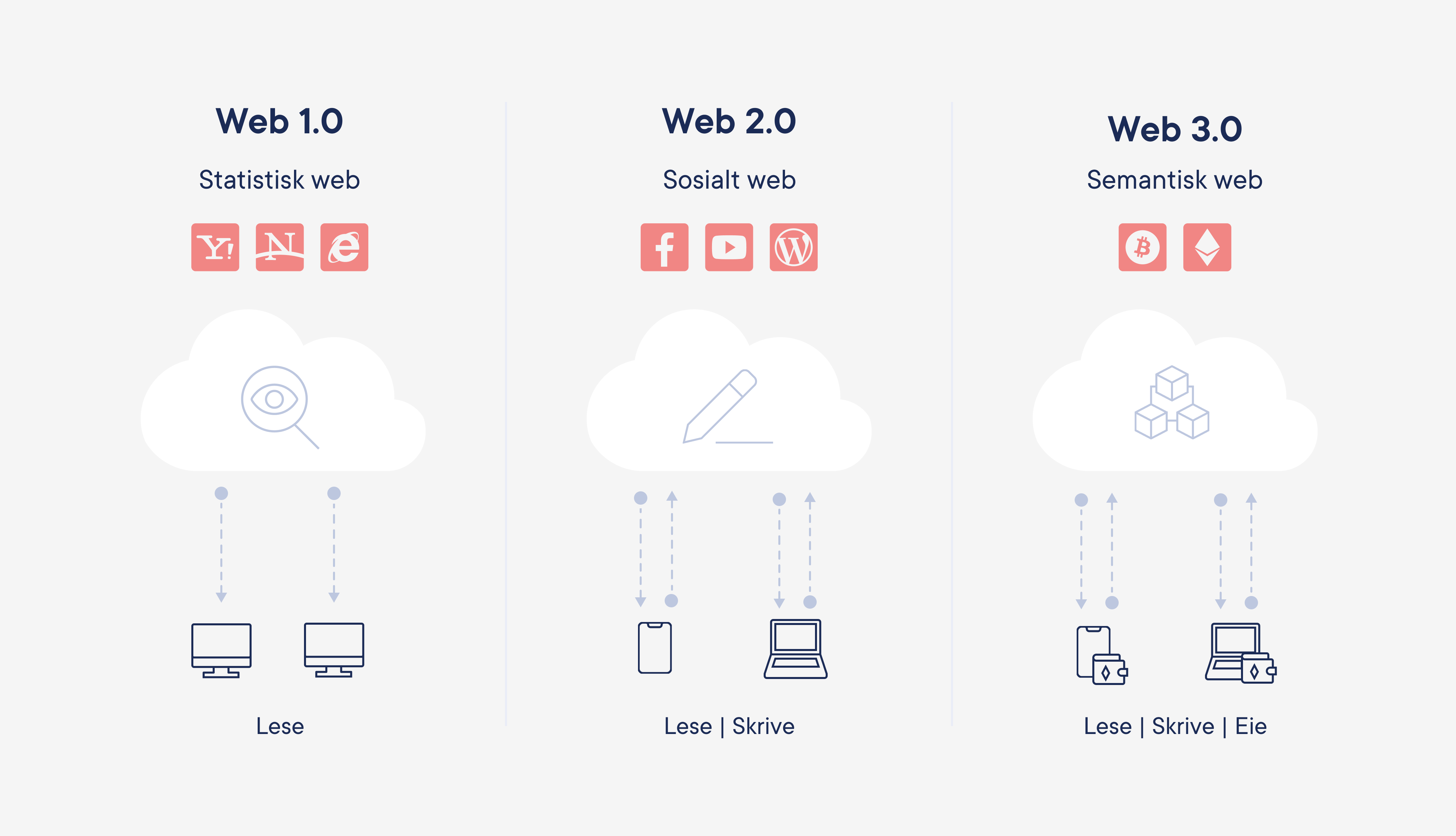
Web 1.0 [1989–2005]
Of the web's early days, Berners-Lee said: "The web is a reflection of humanity." From that we can read that people consist of both positive and negative qualities.
The World Wide Web's first era began in the 1990s. It was a static information provider where people could read and download content. Users could not yet communicate interactively with websites. The user demographic was therefore largely consumers of content rather than creators of content.
Web 1.0 consists of the following technologies:
- HTML (HyperText Markup Language)
- HTTP (HyperText Transfer Protocol)
- URL (Uniform Resource Locator).
Web 2.0 [2005–]
Web 2.0, also known as the social web, made it possible for users to interact with each other on websites. This led to collaboration, social media, and the sharing of content across platforms and applications.
It also became possible to connect to databases for storing and uploading data, which changed how people use the internet. This has led to today's internet society.
Web 2.0 consists of three layers of innovation:
- Social media
- The cloud
- Mobile use
Web 3.0 [gradvis overgang]
Web 3.0 is about decentralization, ownership, and artificial intelligence. It carries forward HTML as its foundation, but changes how data is connected and stored.
Key characteristics include:
- Semantic web (where AI understands the meaning of data)
- Machine learning for smarter content personalization
- Blockchain for decentralized control
- Cryptocurrencies
- NFTs
- DAOs.
How will it change the way we use the internet?
Web 3.0 services will emphasize ownership, security, and intelligent personalization. The changes we can expect include:
Data ownership
Instead of giving away data to centralized companies, users gain control. The blockchain stores data publicly, and users can choose to remain private, interact directly, and profit from their own data.
Exposure to the Metaverse
Web 3.0 and the Metaverse are closely linked through blockchain technology. Cryptocurrency provides economic models for work, trade, and entertainment in virtual worlds. NFTs enable ownership of unique digital objects in the Metaverse.
Token-driven ecosystem
Cryptocurrencies and tokens provide ownership and access to online services without the need for a central authority. This enables new payment models and reduces censorship and exclusion.
Conclusion
Web 3.0 is a decentralized version of the web. While it is still under development, it is important to understand what it entails in order to prepare for the future.
Do you have questions about Web 3.0, or are you wondering how you can apply new technology to achieve better results? Get in touch with us.
Related articles